
Cleanroom Protective Coveralls for ISO Class 5, 7, and 8 Environments: A Buying Guide
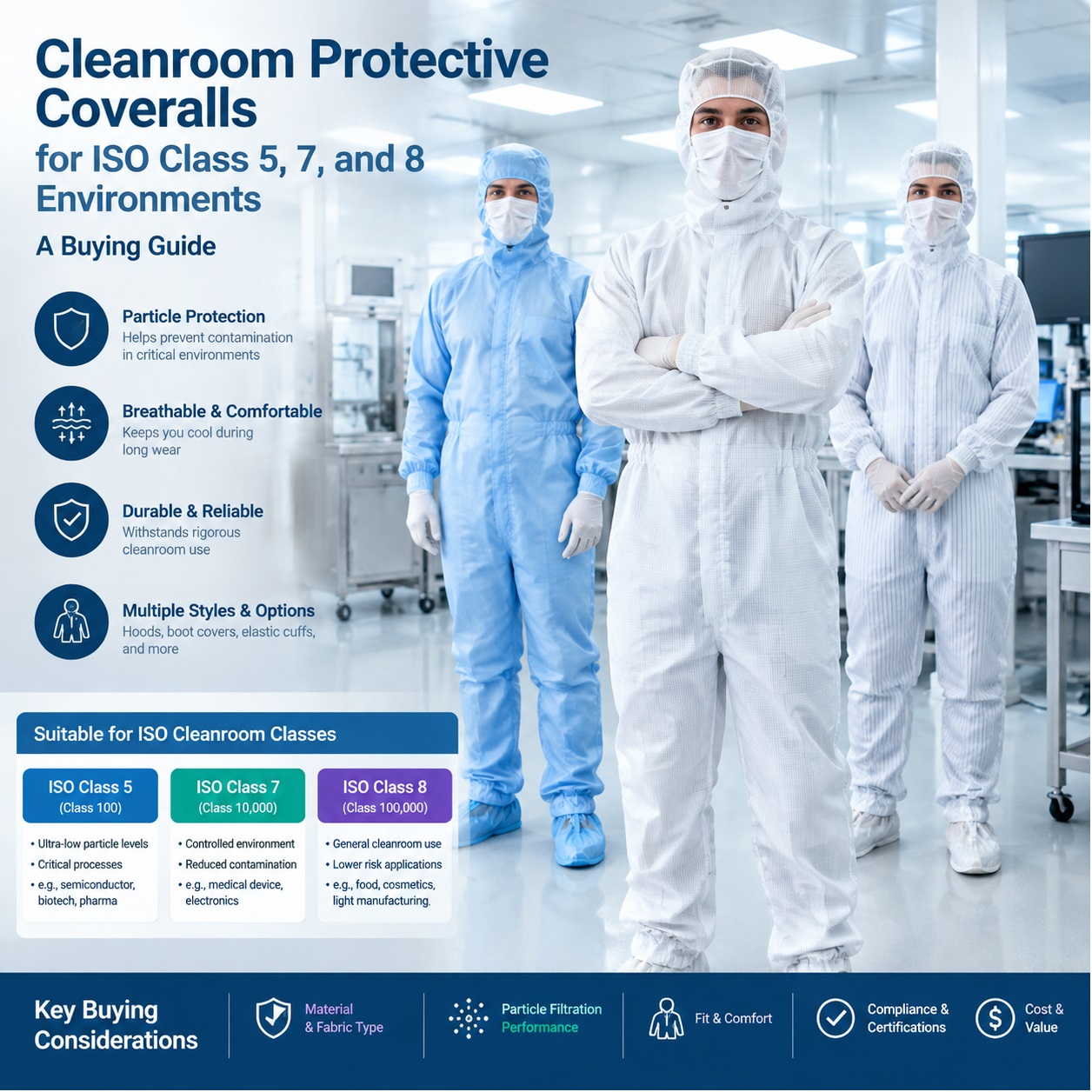 If you’re buying the same coverall for an ISO Class 5 cleanroom and an ISO Class 8 warehouse, you’re either overpaying or underprotecting. Usually both. The ISO class on the door tells you how clean the air must be. It doesn’t tell you what the garment has to do. That’s your job.
ISO 14644-1 sets the particle limits. ISO Class 5 allows no more than 3,520 particles at 0.5 microns per cubic meter. ISO Class 7 allows 352,000. ISO Class 8 allows 3,520,000. Those numbers aren’t abstract. They determine whether a coverall can be a contamination source, a barrier, or both. A coverall is not just clothing. It’s a mobile cleanroom surface. It sheds, traps, and transports particles. It also protects the product and the operator.
Start With The Class, Not The Price.
ISO Class 5 is the tightest of these three. This is aseptic filling, sterile compounding, critical semiconductor work, and other processes where a single viable particle can ruin a batch. The coverall needs to be low-linting, high-barrier, and usually sterile. If the process is sterile, the garment must be sterile and validated. Look for gamma-irradiated garments, individually bagged, with lot traceability and documentation. The material should be a low-particle-shedding fabric such as Tyvek or a comparable high-performance nonwoven. SMS may work in some ISO 5 applications, but don’t assume. Ask for particle-shedding data from a Helmke drum test or equivalent. Check microbial barrier data. Check that seams, zippers, and closures don’t create particle traps.
Design details matter in ISO 5. A hood that exposes hair, a zipper without a flap, or loose cuffs can destroy the control strategy. Look for tunneled elastic wrists and ankles, thumb loops, a full zipper flap, and a snug hood. Boot covers or integrated booties should overlap properly. The coverall should fit well enough to move without tearing but not so loose that it balloons and drags. Comfort is not a luxury here. An operator who is hot, itchy, or restricted will adjust the garment. Every adjustment risks contamination.
ISO Class 7 Is The Workhorse.
ISO Class 7 covers a huge range of operations: pharmaceutical compounding, medical device assembly, electronics, and biotechnology. The particle limit is 100 times looser than ISO 5, but that doesn’t mean you can use a warehouse smock. You still need a cleanroom coverall. The question is how much barrier and sterility you need. If the product is exposed and sterile, use sterile cleanroom protective coveralls. If the process is non-sterile but particle-sensitive, non-sterile low-lint garments may be enough. If there are liquids, powders, or biological materials, choose a fabric with a stronger barrier, such as a microporous film laminate or a coated nonwoven.
For ISO 7, balance matters. A coverall that is too hot will be worn incorrectly. A coverall that is too thin will shed or tear. SMS coveralls are common here because they offer good breathability and reasonable particle control. Microporous film coveralls offer better liquid resistance but can be warmer. Test samples with actual operators in actual gowning rooms. Watch how they don and doff. Check for gaps at the wrists, ankles, and neck. A good ISO 7 coverall should disappear into the process. The operator should forget about it, and the environmental monitoring should stay in control.
ISO Class 8 Is Controlled, Not Careless.
ISO Class 8 is often the lowest classification in a cleanroom suite. It may be a gowning room, a packaging area, or a less critical manufacturing space. Coveralls here are usually disposable and non-sterile. That does not mean anything goes. The garment still needs to be low-linting and durable. It still needs to fit. It still needs to be changed on a schedule. A dirty coverall in ISO 8 can carry contamination into ISO 7 or ISO 5. Contamination control is cumulative. The gowning room is part of the process.
For ISO 8, many buyers choose lightweight SMS or polypropylene coveralls to control cost. That can work if the fabric is cleanroom-compatible and the supplier controls particle shedding. Avoid industrial coveralls with untested fabrics, exposed zippers, or loose threads. They may look cheap, but they can cost you in environmental monitoring excursions and audit findings.
What To Put In The Specification.
Write the specification around the process, not around a catalog number. State the ISO class. State whether the garment must be sterile. State the required fabric and seam type. State the particle-shedding limit. State the microbial barrier requirement if applicable. State the size range and fit expectations. State the packaging. State the lot traceability and expiration date. State whether the garment needs to be ESD-safe. If you are in pharma, align the requirement with EU GMP Annex 1 and your own contamination control strategy. If you are in medical devices, align it with ISO 13485 and your cleanroom procedures.
Ask for documentation before you buy. A supplier who cannot provide lot-specific certificates, irradiation records, or particle-shedding test reports is not a cleanroom supplier. They are a clothing vendor. For sterile coveralls, ask for gamma irradiation dose verification, bioburden data, and sterility assurance level. For non-sterile coveralls, ask for particle shedding, lint, and microbial penetration data. Check that the garments are manufactured and packaged in a controlled environment. Check that the packaging itself won’t shed particles when opened.
The Hidden Costs Of Cheap Coveralls.
The purchase price is the smallest number on the spreadsheet. The real cost shows up in rejected batches, repeat environmental monitoring, operator downtime, and audit observations. A coverall that tears during gowning wastes time and materials. A coverall that is uncomfortable causes bad gowning habits. A coverall with inconsistent sizing creates gaps and exposed skin. A coverall without documentation creates risk. You may save a few cents per unit and spend thousands on corrective actions.
Fit trials are not optional. Bring in samples from at least two suppliers. Have operators from different shifts and body types wear them for a full shift. Watch for restriction, heat buildup, and particle generation at the seams. Check the donning process. If the coverall requires three people to close the zipper, it is the wrong coverall. If the hood falls back when the operator looks down, it is the wrong coverall. If the booties twist or slip, it is the wrong coverall.
Questions To Ask Every Supplier.
Can you provide lot-specific particle-shedding data? Can you provide sterile validation for gamma-irradiated garments? What is the fabric composition and seam construction? What is the recommended ISO class for this garment? Is it cleanroom laundered or single-use? What is the shelf life and storage requirement? Can you support a trial with multiple sizes? Can you scale supply without changing materials or manufacturing sites? Do you understand Annex 1, ISO 14644-1, and IEST-RP-CC003? The answers will separate a partner from an order taker.
Buying cleanroom coveralls is not about finding the cheapest disposable. It is about matching the garment to the contamination control strategy. ISO Class 5 demands a high-barrier, low-particle, often sterile coverall with documentation. ISO Class 7 demands a balanced coverall that controls particles and keeps operators comfortable. ISO Class 8 demands a reliable, low-lint coverall that doesn’t undermine the cleaner spaces next door. Get the class right, get the data right, and get the fit right. Then the coverall does its job: it protects the product, the process, and the people who run it.