
Continuous Mixer vs. Batch Mixer: Which One Delivers Higher Throughput for Mass Production?
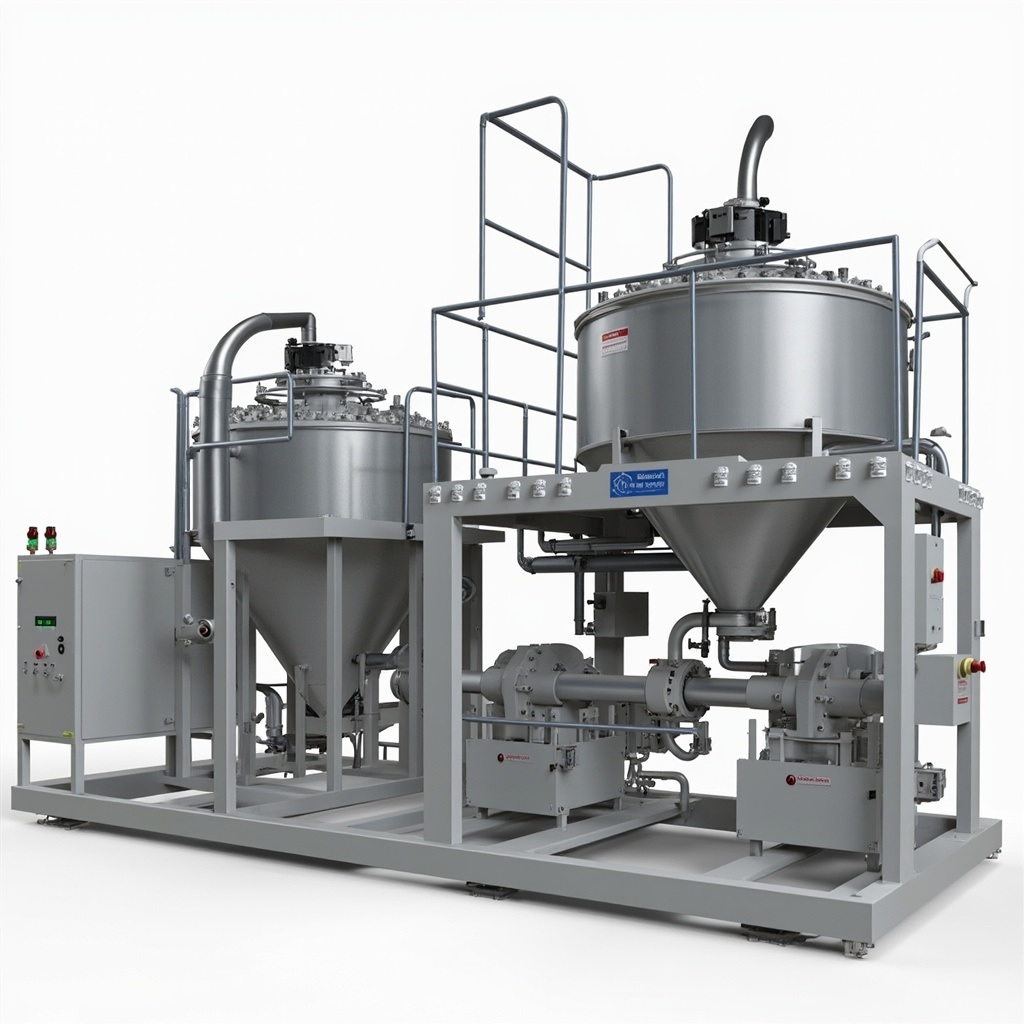
If you are running a high-volume production line, the last thing you want is a bottleneck sitting right in the middle of your mixing station. I have seen factories where the mixer is treated like the sacred cow of the process—nobody touches it, nobody questions it, and everybody just accepts that the line has to pause every few minutes while the machine catches up. That is a dangerous assumption, especially when you are trying to push out thousands of tons of material per shift. The debate between continuous mixers and batch mixers is not really about which one is “better” in a general sense. It is about which one can keep up with the relentless pace of mass production without forcing you to compromise on consistency.
Let me be blunt: if your goal is raw, unadulterated throughput measured in tons per hour, the continuous mixer wins almost every single time. A batch mixer works in cycles. You load, you mix, you discharge, you clean, and you repeat. That dead time between cycles—the loading phase, the discharge phase, the inevitable pause for scraping the walls—adds up to a significant percentage of your total operating time. In a continuous mixer, material flows in one end and out the other without interruption. There is no stop-and-go. The machine is always running, always processing. For mass production, that uninterrupted flow is the difference between hitting your daily target and scrambling to make up lost time during overtime shifts.
But here is where it gets tricky. Throughput is not just about volume. It is about usable volume. A batch mixer can give you very tight control over each individual batch. If you are mixing expensive ingredients or materials that require precise dwell time, a batch mixer allows you to verify every single load before it moves downstream. A continuous mixer, on the other hand, relies on steady-state conditions. Once it is tuned, it runs like a well-oiled engine, but if something goes wrong—say, a fluctuation in the feed rate or a change in raw material density—you might not catch it until hundreds of kilograms of off-spec product have already passed through. That is a risk you have to calculate.
For companies that have made the switch to continuous systems, the numbers speak for themselves. I have worked with facilities that replaced three batch mixers with a single REFAMIX continuous mixer and saw their output jump by nearly forty percent. The reason is simple: the continuous mixer eliminated the idle time and reduced the need for manual intervention. The operators went from babysitting a machine that needed constant loading and unloading to monitoring a system that ran autonomously for hours. That shift in labor efficiency alone often justifies the investment.
However, do not let the throughput numbers blind you to the reality of your product. If your recipe involves very small percentages of additives that need to be dispersed uniformly, a batch mixer gives you the mechanical advantage of longer residence time and aggressive shear. Continuous mixers have gotten much better at this over the years, especially with advancements in screw design and paddle configurations, but they still require a more carefully controlled feed system. If your pre-feeder is inconsistent, your continuous mixer will produce inconsistent results. Garbage in, garbage out.
Another factor that often gets overlooked is changeover time. In mass production, you are rarely running the same recipe forever. You switch products, you adjust formulations, you clean between runs. With a batch mixer, a full cleanout can take hours because you have to open the door, scrape the interior, and sometimes disassemble the mixing tools. With a continuous mixer, especially a well-designed one like the REFAMIX series, the self-cleaning action of the rotating elements and the ability to run a purge material through the system can cut changeover time by more than half. That is not just throughput—that is uptime.
So which one delivers higher throughput? If you define throughput as “the maximum amount of material you can push through in a given time window with minimal waste,” the continuous mixer is the clear winner. But if your definition includes “the ability to maintain perfect consistency across every single kilogram,” the batch mixer still holds an edge in certain applications. The smartest move is to look at your specific production profile. Are you running one product for weeks at a time? Go continuous. Are you constantly switching between complex formulations? Stick with batch, or consider a hybrid approach.
At the end of the day, the machine does not care about your deadlines. It only cares about physics. You have to choose the tool that matches the rhythm of your process. And if you are serious about mass production, the continuous mixer is the tool that keeps the rhythm going without missing a beat.